Many platforms, ranging from WhatsApp to major banks, no longer stop at simply sending a verification code.
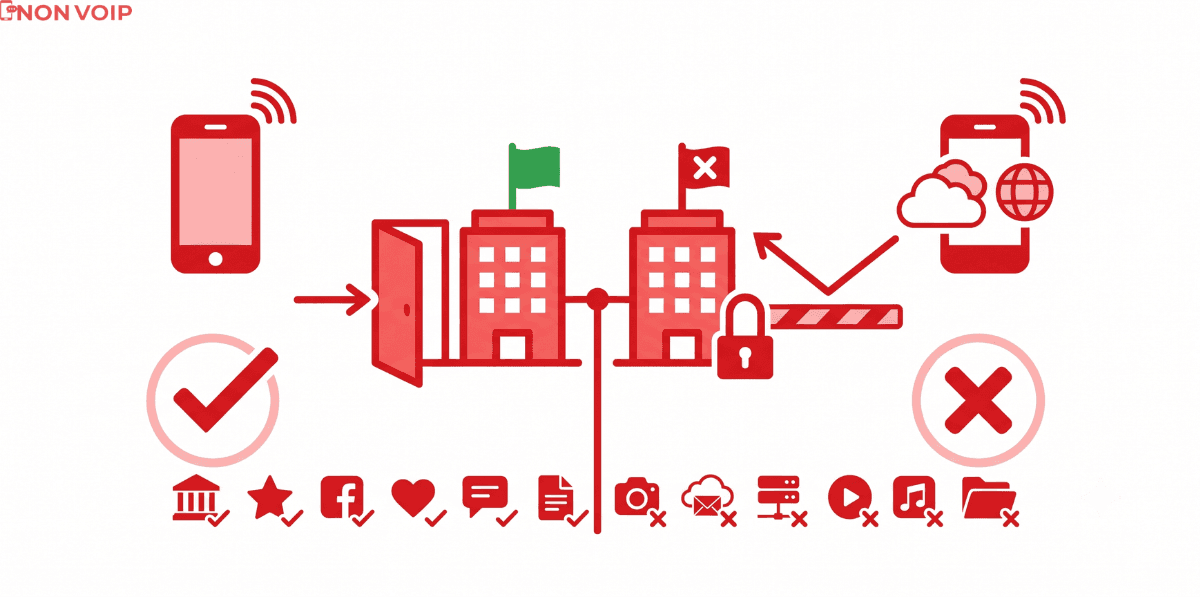
Instead, they first scan the number type using advanced auditing frameworks known as Carrier Lookup or HLR to determine whether it is linked to a physical cellular card ( Non-VoIP Numbers) or a virtual number generated by an internet application (VoIP).
If the lookup result returns "VoIP," the number is instantly rejected and the profile is placed under extra security monitoring.
This article reviews 10 of the most prominent services renowned for their strict stance against VoIP numbers, explains exactly why they enforce these rules, and highlights the practical alternative for anyone needing a number that actually works.
Why Exactly Do Certain Services Prefer Non-VoIP Numbers?
The core concept is that VoIP numbers are incredibly easy to generate and can practically be duplicated without limits, making them the favorite tool for building fake or duplicated accounts in massive quantities.
Platforms that frequently face fraud or duplicate accounts deploy virtual number blocking as a primary line of defense.
Conversely, a Non-VoIP number is bound to a physical SIM card and an actual telecom carrier, making its duplication or manipulation significantly harder and much more expensive.
Top 10 Services accept Non-VoIP Numbers only
1. WhatsApp
WhatsApp is one of the most stringent applications in this regard, particularly when dealing with new or multiple accounts.
Free virtual numbers are mostly rejected right at the registration attempt, as WhatsApp is specifically known as one of the platforms that explicitly blocks VoIP numbers.
Even if the code is initially accepted, the account might be suspended later if the system detects that the line is not tied to a physical SIM card.
Read More: How to Activate a WhatsApp Account with a US Non-VoIP Number
2. Telegram
Telegram follows a similar logic to WhatsApp, although it can be slightly less rigid in specific scenarios.
The biggest hurdle appears with shared public numbers, where the exact same line has likely been used thousands of times by other users, causing it to be pre-listed on the platform’s internal blocklists.
Read More: How to Activate a Telegram Account with a US Non-VoIP Number
3. Dating Apps: Tinder, Bumble, and Hinge
This category represents some of the most challenging environments for VoIP numbers because their fake-profile detection engines are engineered specifically to combat automated bots.
Dating platforms like Tinder, Bumble, and Hinge are known to be highly aggressive against bots; thus, any number flagged as virtual is usually rejected right from the first step, regardless of its price or origin.
4. Google / Gmail
Google does not block VoIP numbers entirely like other platforms do, but it imposes strict limits on the number of profiles associated with the same line.
Effectively, Google enforces a tight ceiling of around 4 to 5 accounts per phone number, meaning any attempt to create multiple accounts with a single line will hit this cap quickly, regardless of the number type.
Read More: How to Activate a Gmail Account with a US Non-VoIP Number
5. PayPal
PayPal treats phone numbers as a core component of its financial risk assessment framework, rather than just a communication channel.
Because of this, number acceptance varies based on context: a virtual number might succeed in executing two-factor authentication (2FA) during login, but it often fails when creating a brand-new account from scratch.
This means the most sensitive phase is the initial registration, not daily subsequent usage.
Read More: How to Activate a PayPal Account with a US Non-VoIP Number
6. Venmo & Cash App
As apps designed for direct peer-to-peer money transfers, this category falls under "strict fintech" verification.
VoIP numbers, especially free public lines, are almost permanently rejected here because any loophole in verification could mean direct financial fraud risks, rather than just a fake profile on a social network.
7. Uber
Uber might not immediately come to mind as a service that is strictly against VoIP numbers, but because it tethers the account to an actual geographical location and a real payment method, it is highly sensitive to any line that appears unlinked to a physical device or a realistic location, especially during initial registration.
Read More: How to Activate an Uber Account with a US Non-VoIP Number
8. Banks and Strict Financial Services
This category is the most stringent of all. Major banking institutions like Chase, Wells Fargo, and Bank of America, alongside government portals like the IRS and Social Security, sit at the top of the pyramid in rejecting VoIP numbers.
Generally, there is no practical alternative here except a real number linked to a physical SIM card registered under the user's name.
Read More: How to Activate a Coinbase Account with a US Non-VoIP Number
9. Discord
Discord is relatively less rigid than the previously mentioned categories, but it enforces phone verification, specifically when detecting a large volume of accounts being created from the same device or network infrastructure
a scenario where VoIP numbers are heavily utilized, making them a direct target for its banning systems.
Read More: How to Activate a Discord Account with a US Non-VoIP Number
What is the Actual Difference Between a VoIP and a Non-VoIP Number?
VoIP Number: Generated via an app or internet service, completely unlinked to any physical SIM card, and often subject to being recycled and reused by multiple users.
Non-VoIP Number: Issued by an actual telecom carrier and tied, even if temporarily, to a physical SIM card, causing it to display across auditing networks as a standard mobile line.
The Practical Factor: Verification systems do not differentiate based on price or the brand name of the provider; instead, they audit based on the line's official classification within global telecom carrier databases.
Read More: The Technical Difference Between VoIP and Non-VoIP Numbers
How to Verify That the Number You Are Using is Truly Non-VoIP?
Check Provider Details: Ensure that your service provider explicitly states the numbers are issued via real, SIM-based cellular networks, rather than just labeling them as "high-quality virtual numbers."
Avoid Shared Public Lines: Stay away from public numbers used by thousands of individuals before you, as they are mostly burnt out and pre-listed on major platform blocklists.
Opt for Dedicated Lines: If you require the number for more than a single verification process (such as resetting your password later), consider a dedicated number rather than a one-time line that returns to the inventory pool immediately after use.
Frequently Asked Questions (FAQ)
What is the fundamental difference between a VoIP and a Non-VoIP number?
A VoIP number operates entirely over the internet without a physical SIM card, while a Non-VoIP number is officially issued by a telecom carrier and classified as a standard mobile line in carrier lookups.
Is using a Non-VoIP number for verification legal?
Yes, utilizing a Non-VoIP number for registration and account verification is a perfectly legal and legitimate practice to preserve privacy, provided that the usage does not violate the destination platform's terms of service.
Why are some VoIP numbers rejected even if they are "paid" or "premium"?
Because classification is determined by the telecom networks' database itself, not by the price or branding of the provider. Even a paid number remains a VoIP line if it lacks a physical SIM card foundation.
Do all services block VoIP numbers to the same degree?
No, some platforms like Google permit them but with tight restrictions on account volume, while other services like banks and dating apps reject them almost entirely right from the first step.
Conclusion
Knowing which services strictly scrutinize number types saves massive amounts of time and prevents you from falling into an endless loop of retries.
If the service you are trying to register on is part of this list, the fastest solution is ensuring from the absolute beginning that the line used is genuinely Non-VoIP, rather than a virtual number marketed as one.