You tap claim reward on an app, and twenty cents or a few extra points appear, not even enough for a cup of coffee, yet you still feel a small, inexplicable rush of satisfaction.
This reaction is exactly why earning money apps feel satisfying even when the reward is small, and it's no accident. It's a carefully engineered psychological mechanism that app designers rely on to bring you back every day.
Quick Summary (TL;DR)
Earn-money apps feel satisfying even though each reward is small because the brain responds more to how quickly and how often a reward arrives than to its size.
A short task that ends within minutes with an instant, known-value payout creates a fast loop of accomplishment and reward, pushing you toward the next task.
Since most of these apps, surveys, product-testing platforms, and paid games are US-based and require a US phone number to sign up, Non-VoIP provides a real, dedicated US number for each app to get through that step.
Why earning money apps feel satisfying despite tiny payouts?

Most of these apps actually show you the reward amount and estimated time before you start a task, so the payout isn't hidden, it's known upfront, just small.
Even so, the brain still releases dopamine, because what drives that response isn't the size of the reward but how fast and how often it arrives.
Each short task that wraps up in minutes with an instant payout reinforces a tight loop of task → completion → reward, and that rapid repetition builds a cumulative sense of progress, even when any single reward is modest on its own.
There's also a separate layer of uncertainty that has nothing to do with the task's price: you might get screened out of a survey partway through and receive only a partial consolation reward, new tasks appear on an irregular schedule, and surprise bonuses sometimes stack on top of the regular payouts.
That mix, a small, known reward plus unpredictable extras around it, is really the answer to why earning money apps feel satisfying even when the reward is small.
For a deeper look at how different reinforcement schedules work, see Simply Psychology's guide to schedules of reinforcement.
How Earn-Money Apps Are Designed Around This Behavior
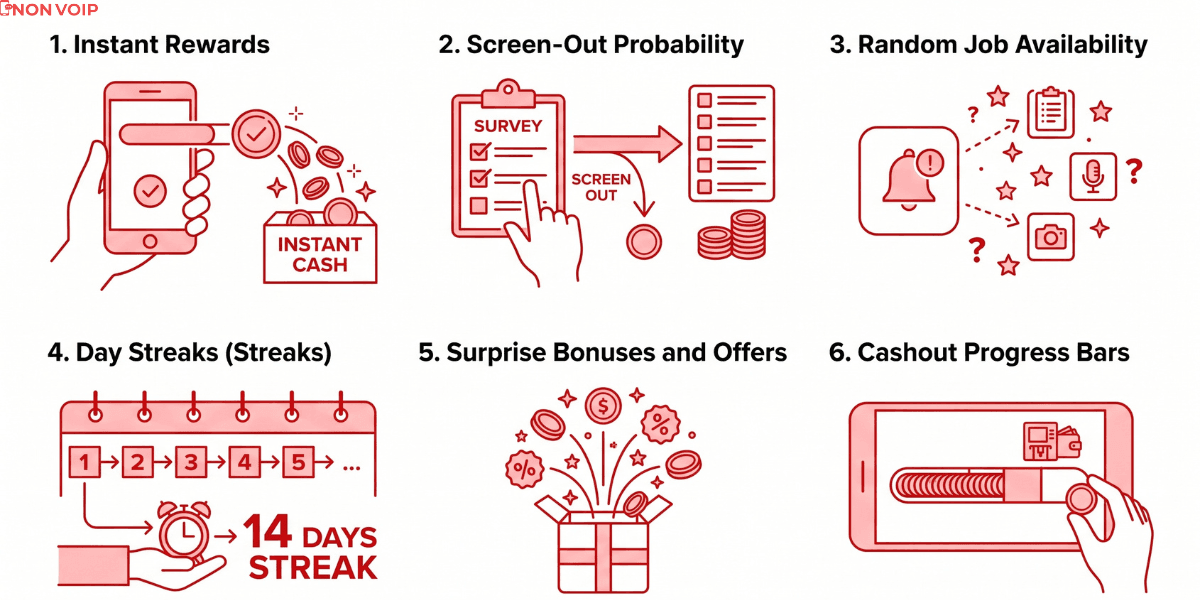
These apps build their entire user experience around this principle through:
- Instant, known-value rewards: you know the amount before you start, but it lands within minutes rather than days, reinforcing a fast completion loop.
- Early screening risk: you may get screened out of a survey after the first few qualifying questions and receive only a small partial reward instead of the full one.
- Irregular task availability: you never know exactly when a new task or survey that fits your profile will appear, which keeps you checking the app frequently.
- Daily streaks: a daily reminder that taps into the fear of losing a streak you've built over several days.
- Surprise bonuses and limited-time offers: extra rewards that appear irregularly on top of the standard payouts.
- Progress bars toward a cashout goal: the feeling of getting close to the minimum withdrawal threshold pushes you to complete just a few more tasks.
Main Types of Earn-Money Apps
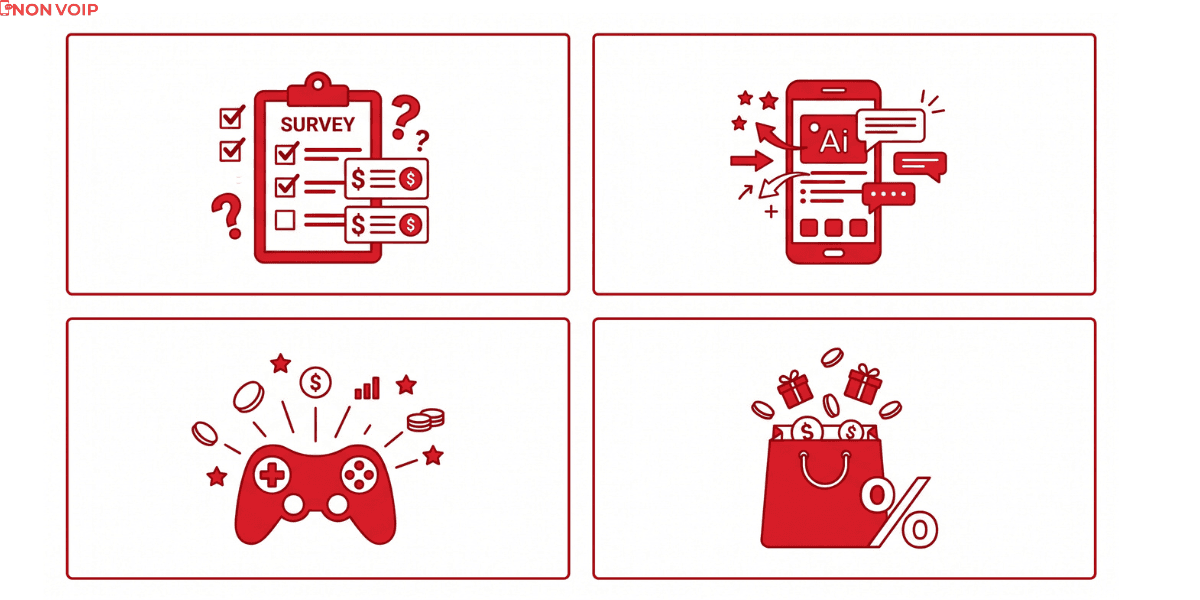
These apps differ in the kind of tasks they require, but they all rely on small, frequent rewards. The main categories include:
- Paid survey apps: such as Swagbucks, Toluna, and YouGov, which pay you for answering market-research questions.
- Product and app testing platforms: such as Dscout and UserTesting, which pay for trying out a product or website and giving feedback.
- Paid gaming apps: such as Mistplay, where you earn points for trying new games and reaching certain levels.
- Cashback and rewards apps: which return a percentage of your spending or offer points for watching ads.
Read more about Best Survey Sites in 2026: Earn Rewards with Paid Surveys
Why Do These Apps Require a US Phone Number to Sign Up?
Most of these platforms are American companies at their core, and they rely on SMS verification (OTP) as a baseline measure to confirm that each account belongs to one real user and to protect their systems from duplicate or fake accounts.
In practice, this means anyone signing up from outside the United States needs a working US phone number to receive the activation code, something most users outside the US simply don't have.
How Non-VoIP Numbers Help You Activate These Apps
Non-VoIP provides real US phone numbers and assigns a separate number to each app you want to activate, since these are genuine numbers tied to real SIM cards, not virtual numbers meant to be recycled across multiple services:
- Receive the OTP verification code right after signing up, with no long wait.
- A number dedicated to each individual app, because a real number isn't shared across multiple services the way temporary virtual numbers often are.
- The number stays stable afterward for password recovery or two-factor verification on that same app.
- Support is available to help you choose the right number for the specific app you're activating.
Tips for Using Earn-Money Apps Mindfully
Understanding the psychology behind these apps doesn't mean you should stop using them; it means using them more deliberately:
- Weigh each task's payout against the time it takes before you start, since the number shown is its real price.
- Set a fixed time of day for checking the app instead of opening it randomly and repeatedly.
- Treat these apps as a small side income, not a primary source of earnings.
- Avoid any app that asks for sensitive banking details or personal information it doesn't actually need for signup.
Frequently Asked Questions
why earning money apps feel satisfying even when the reward is small?
Because the brain responds more to how fast and how often a reward arrives than to its size, a short task that ends in an instant payout creates a repeating loop of accomplishment that drives you to the next task.
Are earn-money apps trustworthy?
Most well-known apps like Swagbucks, Toluna, YouGov, and Mistplay are legitimate and do pay out, but earnings are typically modest and better suited as side income rather than a primary one. It's best to avoid any app that asks for unnecessary sensitive banking details.
Why do earn-money apps require a US phone number to sign up?
Because they're US-based platforms that rely on SMS verification (OTP) to confirm each account belongs to one real user, which requires a working US number capable of receiving text messages.
What's the difference between a real number and a virtual number when signing up for these apps?
A real (Non-VoIP) number is tied to an actual SIM card and dedicated to one app, while a virtual number is often temporary and can be used by multiple people for the same service at once.
Can I use the same Non-VoIP number for more than one app?
No, each number is dedicated to a single app, since it's a real number rather than a virtual one meant to be reused across multiple services.
Final Thoughts
Understanding why every small reward feels satisfying gives you a more mindful relationship with these apps, instead of staying caught in the loop without knowing why.
And once you decide to try one of these platforms, having a real, dedicated US number through Non-VoIP removes the first technical barrier to completing signup.